
Maharishi's Programmes
Key Elements of Maharishi Sthapatya Veda
Key Elements for Buildings and Communities
According to Maharishi Sthapatya Veda, health, good fortune, and the development of higher states of consciousness are profoundly influenced by the Vastu, which includes the orientation of the building, its position on the site, the slope of the land, the direction of entrances, building proportions, room placement, and the orientation of the surrounding roads.
Maharishi Sthapatya Veda provides precise knowledge and time-tested Vedic formulas to determine the most beneficial orientation, placement, and proportion for every building.
One of the most important principles of building in harmony with Natural Law is the correct orientation with respect to the path of the sun, the strongest influence of Natural Law on Earth. Therefore, Maharishi Sthapatya Veda recommends that the main entrance of a building face the East. Entrances facing South are considered the least auspicious and are believed to bring negative influences to the occupants. (Read the Footnote on Human Brain Sensitivity to Orientation)
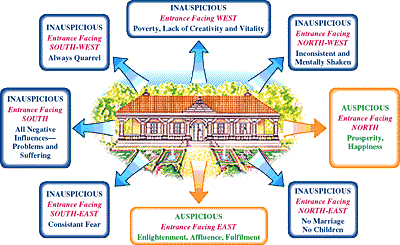
Another essential feature of Maharishi Sthapatya Veda is the Brahma-Sthan—a central garden square in a town, or a central court or atrium in a house. It represents the seat of Total Natural Law, connecting individual life with Cosmic Life and individual intelligence with Cosmic Intelligence.
Maharishi Sthapatya Veda also recommends low-density housing, non-toxic building materials and furnishings, together with abundant herbal and floral gardens to create a healthy living environment.
Ideal Communities
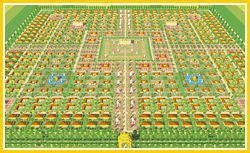
To enjoy the complete benefits of Maharishi Sthapatya Veda, the entire community should be designed according to Natural Law. It provides the knowledge of ideal direction, placement, and proportion for towns and cities so that community planning naturally promotes health, harmony, prosperity, and good fortune for everyone.
Site Selection with Reference to Auspicious Environmental Parameters
- Careful and purposeful site planning.
- Layout with perfect orientation to the East.
- Low-density housing.
- Non-toxic and energy-efficient construction.
- Adequate fresh air and ventilation.
- Generous green spaces and landscaping.
- Use of non-polluting vehicles.
- Solar and other cost-effective, non-polluting energy sources for energy self-sufficiency.
- Sustainable organic local agriculture for food self-sufficiency.
- Maharishi Vedic Science and Technology for ideal education, prevention of crime and disease, and economic self-sufficiency.